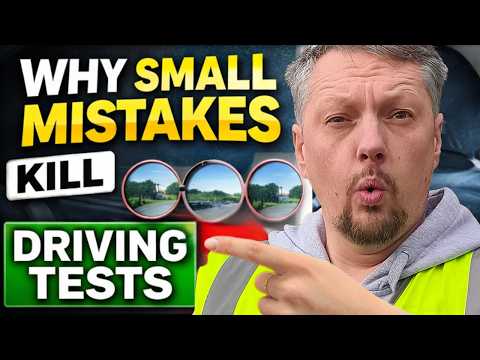
Did you know that the national average UK driving test pass rate currently stands at just 51.8%? That means nearly half of all tests result in a fail! With the DVSA conducting countless tests across its 322 centres annually, hundreds of thousands of learners face disappointment. But what if you could avoid the most common pitfalls?
We teamed up with top driving instructor Josh Ramwell to break down the 10 most frequent mistakes that lead to failure. Forget being another statistic – follow this expert advice from Driving Test Expert to boost your confidence and pass your driving test first time!
The Foundation of Safe Driving: Awareness & Communication
When you're behind the wheel, your awareness and how you communicate with other road users are paramount. These aren't just 'good habits'; they're core components examiners look for.
- Poor Observation & Awareness: This is arguably the biggest culprit. Examiners want to see you constantly scanning – looking ahead, checking mirrors, assessing risks, and understanding your surroundings. Don't just look, see! This means actively processing what's happening around you, anticipating potential hazards (like a ball rolling into the road or a car indicating a turn), and adjusting your driving accordingly. Are you scanning left and right at crossroads? Are you aware of cyclists or pedestrians? Missing these crucial observations can lead to serious faults.
- Insufficient Mirror Checks: Your mirrors are your best friends on the road. Failing to check them at critical times is a common fault. You MUST check your mirrors:
- Before signalling
- Before changing speed (accelerating or braking)
- Before changing direction (steering)
- When approaching junctions
- When moving off
- Incorrect or Missing Signals: Signals are how you tell other road users your intentions. A common mistake is signalling too late, too early, or not at all. Make sure your signals are clear, timely, and cancelled once they've served their purpose. For instance, if you're turning left at a junction, signal well in advance so others know your plan. Don't forget to cancel your signal once you've completed the manoeuvre!
Mastering Road Dynamics: Navigating Junctions & Roundabouts with Confidence
Navigating different road scenarios smoothly and safely is a true test of your driving ability. These common mistakes often stem from a lack of confidence or understanding of road rules.
- Inappropriate Speed Control: Speed isn't just about staying within the limit; it's about driving at a speed appropriate for the conditions. Driving too slowly can hold up traffic and frustrate other drivers, while driving too fast for conditions (e.g., poor weather, narrow streets, approaching junctions) is dangerous. Your examiner wants to see you drive confidently but safely, maintaining good progress without rushing or dawdling.
- Poor Junction Negotiation: Junctions are notorious for test failures. Common errors include:
- Hesitation: Waiting for a gap that's perfectly safe, rather than taking a reasonable opportunity.
- Incorrect Positioning: Being too far left or right, or not positioning correctly when turning right.
- Poor Observation: Not effectively checking all directions for traffic and pedestrians.
- Creeping: Rolling out too far into the junction without a safe gap.
- Roundabout Woes: Roundabouts can be daunting, but breaking them down makes them manageable. Common faults include:
- Incorrect Lane Choice: Using the wrong lane for your exit.
- Poor Signal Use: Signalling incorrectly on approach or failing to signal off.
- Failing to Give Way: Not giving way to traffic already on the roundabout or approaching from the right.
- Inappropriate Speed: Entering too quickly or too slowly, making it hard to react.
Precision & Control: Flawless Manoeuvres & Emergency Responses
Your driving test isn't just about moving forward; it's about demonstrating precise control in specific situations and being ready for the unexpected. You'll be asked to perform one of the four DVSA manoeuvres, and the emergency stop might also feature.
- Manoeuvre Faults (Parking & Reversing): Whether it's the parallel park, bay park, or pull up on the right and reverse, poor observation and control are common test killers. Examiners are looking for:
- All-round Observation: Constantly checking your surroundings, particularly your blind spots, throughout the manoeuvre.
- Control of Speed: Maintaining a slow, controlled speed.
- Accuracy: Not hitting the kerb forcefully (a minor tap might be tolerated but repeated or harsh contact is a major).
- Awareness: Being mindful of other road users, pedestrians, and fixed objects.
- Failing the Emergency Stop: This isn't about how quickly you can stop, but how quickly and safely you react. Common faults include:
- Slow Reaction Time: Not braking immediately and firmly when instructed.
- Loss of Control: Skidding significantly or losing control of the steering.
- Poor Observation Afterwards: Forgetting to check mirrors and blind spots before moving off again.
- General Control Issues (Stalling, Jerky Movements): While a single stall might be a minor fault, repeated stalling or jerky driving (harsh braking, sudden steering, poor clutch control) suggests you lack confident control of the vehicle. This can lead to multiple minor faults that add up, or even a serious fault if it causes a dangerous situation. Focus on smooth gear changes, precise steering, and gentle use of the accelerator and brake.
Key Takeaways
- Prioritise all-round observation: Always scan and anticipate hazards.
- Master mirror checks: Use them before changing speed, direction, or signalling.
- Communicate clearly: Ensure your signals are timely, correct, and cancelled.
- Adapt your speed: Drive appropriately for conditions, not too fast or slow.
- Practice manoeuvres until perfect: Focus on observation and control throughout.
- Stay calm and confident: Hesitation and lack of control often lead to faults.
Learner Hub
Turn this into a recovery plan
Use the Learner Hub to translate the mistake or fault pattern into focused practice before choosing the next test date. This starts with observations selected as the focus.
Frequently Asked Questions
What are the most common driving test mistakes?+
The most common mistakes leading to failures include poor observation at junctions, ineffective use of mirrors, incorrect signalling, inappropriate speed control, and issues with manoeuvres like parking. These typically relate to a lack of awareness, anticipation, or vehicle control, as highlighted by expert instructors and DVSA data.
How can I avoid minor faults on my driving test?+
To avoid minor faults, focus on consistent, thorough observation (checking mirrors, blind spots), smooth vehicle control (steering, gears, clutch), and clear communication (correct signalling). Practice the 'commentary driving' technique to vocalise your observations and intentions, helping you to stay aware and making your actions evident to the examiner.
What's the national driving test pass rate in the UK?+
The national average UK driving test pass rate is 51.8% based on DVSA data for April 2024 to March 2025. This means that slightly more than half of all candidates successfully pass their test. Pass rates can vary slightly by test centre and geographical location.
How important are mirror checks in a driving test?+
Mirror checks are extremely important. They demonstrate constant awareness of your surroundings and are crucial for safe driving. Examiners expect you to check your mirrors before signalling, changing speed or direction, and as part of your general observation. Failing to use mirrors effectively is a very common fault that can quickly lead to a failed test.